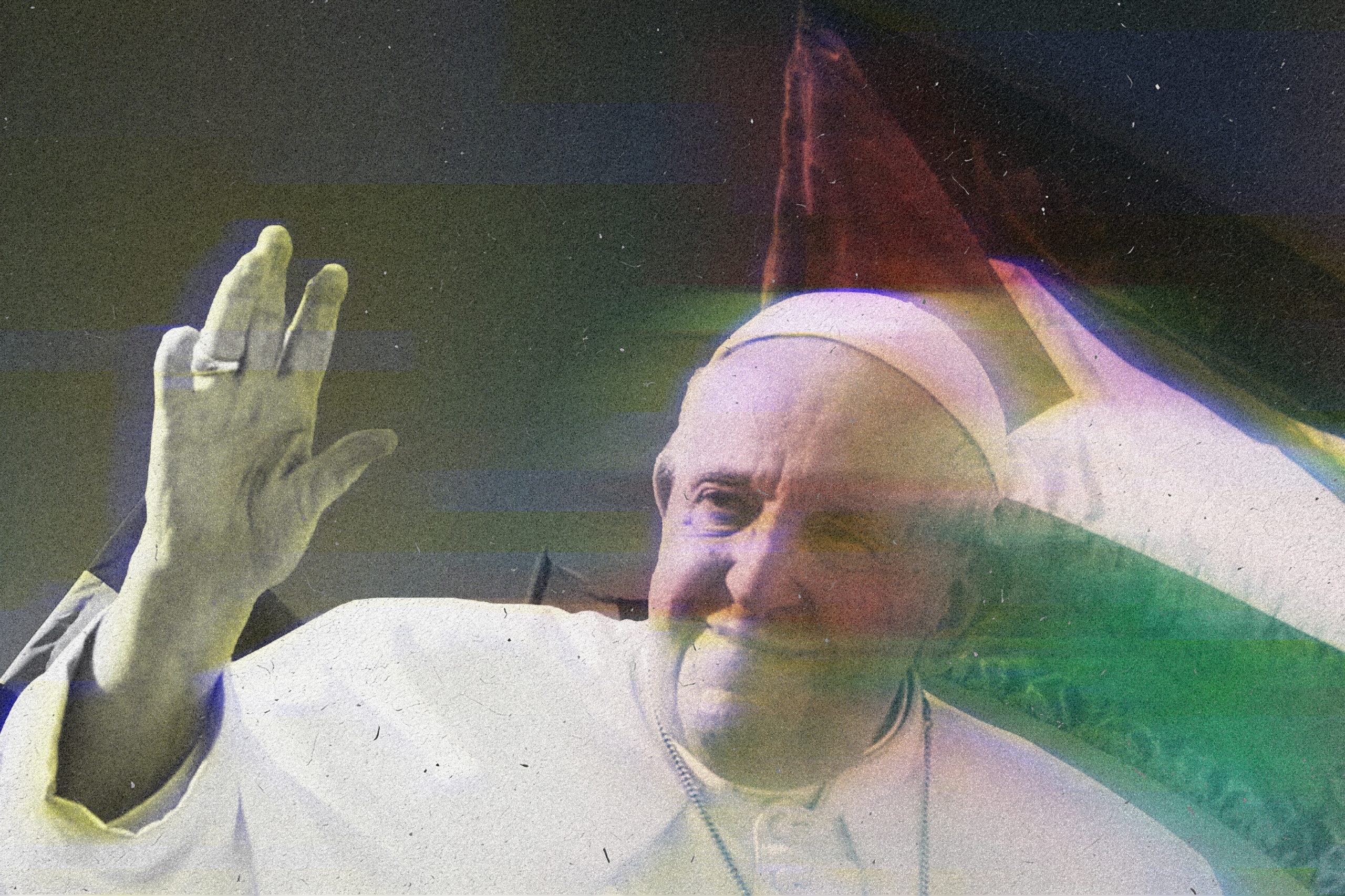
Pope Francis passed away on April 21, 2025, after more than a decade of holding the highest position in the Catholic Church. He left an impactful legacy of open-mindedness, empathy, and progress, with some even dubbing him jokingly, “the Woke Pope”. He angered right wing Catholics who openly rejected his acceptance of queer folk and criticism of the Trump administration. With the position vacant, we all held our breath in anticipation of who would follow such a legacy.
Would it be the Filipino prelate, Luis Tagle, who shares a similar progressive message to Francis in regards to uplifting the downtrodden, or would it be a more conservative member like Cardinal Robert Sarah from Guinea who was a critic of Francis? The church chose to go down the middle with a comprise for everyone. Before we knew it, the white smoke was released from the Vatican, and the crowd below was looking up at their new Pope: an American.
He was born in the land of deep dish pizza, Chicago. The Pope roster has never included a US native, and it was a complete surprise to many. Jose Casanova, a senior fellow at the Berkley Center, said Pope Leo XIV was chosen “because he’s the best candidate to unify the church today”. In other words, the church desired a centrist. This appeal to a wider audience is reflected in Leo’s politics, which are much less radical than his predecessor. Leo has voted in multiple Republican primaries as recently as 2024. In a 2012 address, he expressed concern that “Western culture” promotes “enormous sympathy for beliefs and practices that are at odds with the Gospel”. During his stay in Peru, he denounced the teaching of gender, taking a more conservative stance on queer rights in comparison to Francis.
However, like most Americans, his politics are all over the place. Despite voting in Republican primaries, he has denounced the current administration’s treatment of migrants, speaking out against the deportations to CECOT. He is also an advocate for environmental issues despite Republicans’ neglect of climate change. Ultimately, he was appointed by Francis as a cardinal, but will he be his spiritual successor?
No one holds a candle to Francis. He was a radical change from previous leaders who would often dwell on reactionary culture war issues like abortion and birth control. Francis put a massive amount of daylight between himself and the rest of the church. He elevated the issue of climate change, denounced the lack of restraint on capitalism, pushed for financial transparency within the Vatican, and advocated for human rights. It was previously normal for leaders to ignore the laity or ordinary members, but Francis pushed for the opposite. He was a man of the people.
In a 2013 interview, Pope Francis proclaimed something strange. When asked, “Who is Jorge Mario Bergoglio?”, his birth name, he admitted he was a sinner. It was this unprecedented admission that the Pope was human and not infallible from criticism. He had room to grow, just like everyone else. It was a sign of humility that marked the legacy he would leave.
In the process of honoring his vow to humility, he intentionally shied away from the lavish lifestyle that was traditional among church leaders. He walked amongst the people, taking selfies with admirers and building bridges between Catholicism and other religions. “For a long time, Catholics were only known for their don’ts — don’t be gay, don’t have an abortion, don’t get a divorce,” Imperatori-Lee told CNN. “Francis unlocked a different kind of Catholicism in the public square. He was somebody who appealed to non-Catholics and Catholics. He was just a decent person.”
Francis intentionally wore white robes instead of the lavish red counterpart. Even his name was a conscious choice. He chose the name Francis in honor of Saint Francis of Assisi, a figure who represented a care for the poor and advocacy for peace. He lived in a modest guesthouse in Vatican City instead of the customary papal apartments. He opted for a Ford Focus instead of the luxury cars his predecessors pranced around in. Every choice was a clear show of humility, that his job wasn’t to be above the laity but to embrace them.
According to CNN, in a 2024 60 Minutes interview, Francis explained his progressive temperament. “When informed that some conservative bishops in the US had complained he was shifting church doctrine in a liberal direction, he responded by saying the term “conservative” can be defined as someone “who clings to something and does not want to see beyond that.“ ”It’s a suicidal attitude,” he added. “Because one thing is to take tradition into account, to consider situations from the past, but quite another is to be closed up inside a dogmatic box.” Francis was determined to challenge the confines of that “dogmatic box” every chance he got. He denounced Trump’s demonization of non-white immigrants, and when a refugee boat sank on a Mediterranean island, he went there and celebrated mass on an altar made of refugee boats.
He took an unorthodox stance on the church’s most historically targeted individuals. Early in his papacy, he proclaimed, “If someone is gay and he searches for the Lord and has good will, who am I to judge?” On one occasion he met with queer church members from the New Ministry and joked and laughed with them for nearly an hour, four times as much time that was promised. As a symbol of his mission to outreach, Francis requested migrants, prisoners, trans people, and the homeless be a part of his final honor guard.
Arguably, his most steadfast dedication was to the Palestinian people, whom he reached out to nearly every day. On average, about 1200 Christian Palestinians lived in Gaza, but since the recent escalation of genocide by the Israeli government, that number has dwindled. About 500 people have sought refuge in Gaza’s Holy Family church compound. To the Palestinian people, he is known as “Baba Francis” or “Grandfather Francis”. With how much contact he kept, he almost resembled a grandfather. The German publication DW interviewed George Anton, who is sheltering with his family at the compound. “Pope Francis stayed in constant contact. He made every effort to reach each of us by phone. From the very beginning of the war until the day before his death, he remained a daily presence in our lives. He never forgot us.”
Gabriel Romanelli, the Argentine priest who serves the Holy Family parish said, “He called us daily, even on the darkest days, under bombardment, when people were being killed and wounded around us…because of the difficult situation in Gaza, it would take three or four hours of trying before the call finally got through. But he never gave up until he reached us.” When Christian Gazans felt abandoned and isolated from the outside world, they always knew Pope Francis was thinking about them. “He was one of the most vocal advocates for the poor and marginalized,” Abu Daoud, 19, told DW. “He consistently opposed war and called for peace and a ceasefire in Gaza and around the world.”
As Pope Leo XIV takes the helm, it’s hard to imagine he could live up to such a legacy, especially considering the role he was chosen to fill. He’s a moderate who shares more regressive views on queer folk but advocates for immigrant rights like his predecessor. Even with this realization, though, the American far right has begun to bash him for not being “America First”. According to the BBC, Steven Bannon, an alt-right Trump loyalist and Catholic said, “It is shocking to me that a guy could be selected to be the Pope that had had the Twitter feed and the statements he’s had against American senior politicians,” Another Trump loyalist, Laura Loomer called Leo “a total Marxist just like Pope Francis”.
On the other side, David Gibson, the Director of the Center on Religion and Culture at Fordham University in New York City, wrote in an essay that “Francis became an increasingly lonely moral voice in a world that was being engulfed by nationalism, disinformation and xenophobia. A world without a pope like Francis will in some ways resemble a Hobbesian dystopia without a prophet pointing to our better angels or a sensible idealist showing a better way,” Gibson wrote.
As the world leans into its worst urges, losing another voice who fought against the status quo is a terrifying reality. Hateful rhetoric, fascist sentiment, and disinformation have infested online spaces and become more and more normalized. It’s troubling, and to come to terms with such an outspoken figure being gone feels symbolic in a way. In this moment, instead of devolving into despair, perhaps it’s better to let Francis’ life inspire us to challenge the world before it’s too late.