What do you think of when you hear the word American? Apple pies, bald eagles, state fairs, and white picket fences? Or does the word evoke nostalgia for some long-gone era of the American dream with perfect lawns in secluded suburbs? Maybe you think about billionaires like Elon Musk and the prospect of piles of money transforming lives. We associate it with so many different things, but perhaps the true meaning is something else entirely.
We’re often told the American dream allows anyone to succeed, regardless of where they come from. The United States prides itself on that aspiration. Yet, for immigrants, that promise can feel like a lie, something the Latino rapper and worldwide sensation Bad Bunny made clear during his acceptance speech at this year’s Grammy Awards.
“We’re not savage, we’re not animals, we’re not aliens,” he said. “We are humans, and we are Americans.” This was in response to the crackdowns by U.S. Immigration and Customs Enforcement, commonly referred to as ICE, and President Donald Trump’s administration over the past year. Trump’s vision of what it means to be an American stands in sharp contrast to Bad Bunny’s. It seeks to portray immigrants as criminals and a threat to society. For this reason, even before Bad Bunny’s trip to the Grammys, he refused to tour in the U.S. out of fear that ICE would raid the concerts.
What’s interesting is that Bad Bunny isn’t even an immigrant. He’s an American citizen born in the U.S. territory of Puerto Rico, yet the current treatment of immigrants is a reflection of how Puerto Ricans have been treated for decades. If American citizens are treated as second-class or expendable, does the word “American” mean anything?
Despite this recognition, Bad Bunny doesn’t dwell on despair. He rode the high of a massively successful tour, was crowned Spotify’s top artist for the fourth consecutive year, and received the opportunity of a lifetime when he was invited to perform at this year’s Super Bowl. He used this platform as an opportunity to paint an uncommon vision of what “American” truly means. This vision doesn’t just include the U.S. but unites both the North and South American continents.
Don’t Let Go of the Flag
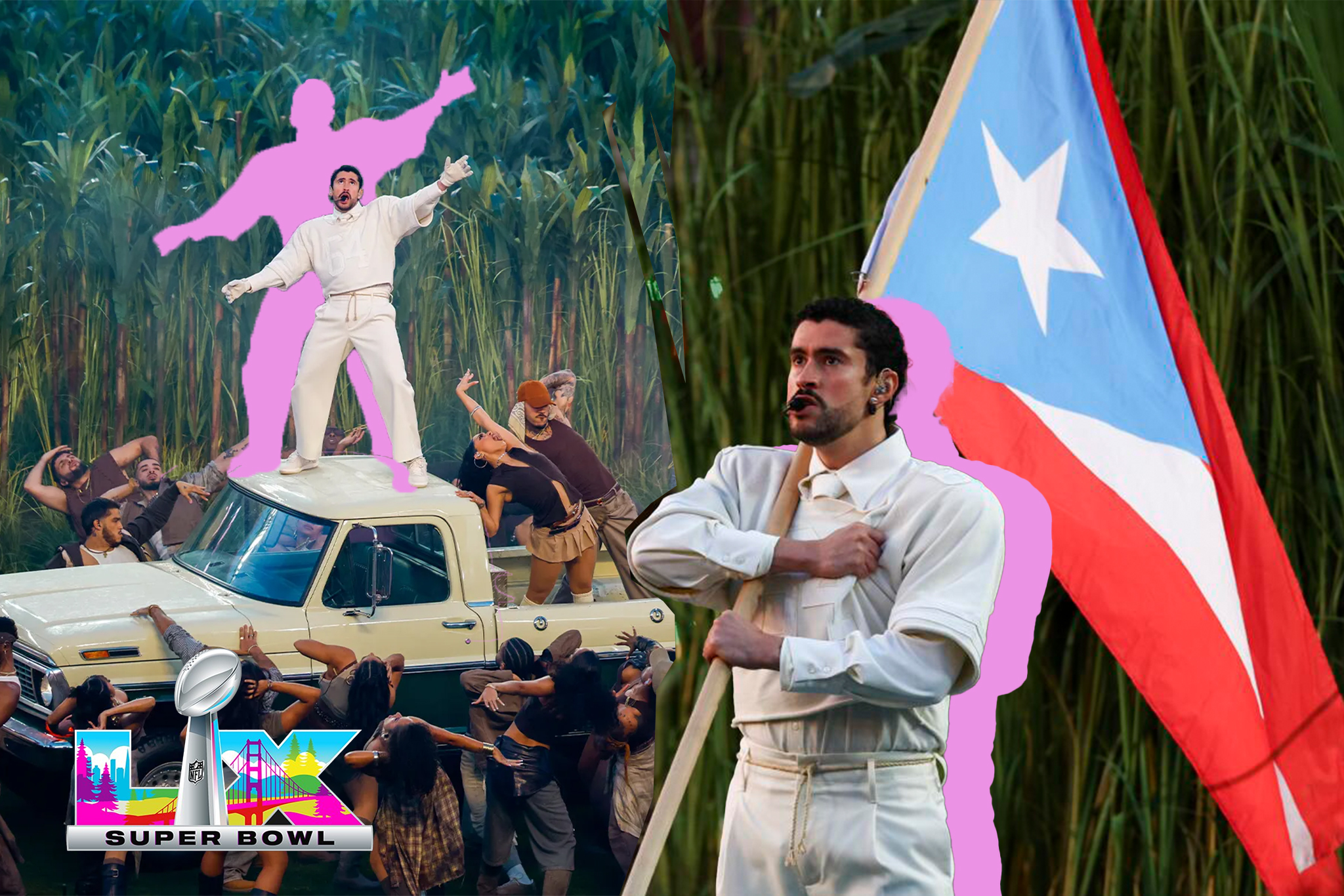
Bad Bunny uses his experience as a Puerto Rican to illustrate the hypocrisy of the “American” dream. His performance was inundated with imagery that every Latino recognizes, including dominoes, plastic chairs, and bodegas. He highlights the beauty of Latin American labor, featuring real beloved business owners like Tonita, the owner of the Caribbean Social Club in New York.
Before Puerto Rico achieved commonwealth status as part of the U.S. in 1952, the Puerto Rican Legislative Assembly passed a Gag Law to quell the independence movement. The singer pays homage to Puerto Rican independence, waving around the light blue version of the flag that was once made illegal. In his song “La Mundanza,” he sings, “Aquí, mataron gente por sacar la bandera. Por eso es que ahora yo la llevo donde quiera,” which translates to, “Here they killed people for raising the flag. That’s why now I bring it wherever I want.”
As he sings “El Apagón,” he climbs atop a light pole. Sparks fly, and electrical workers work tirelessly to fix it beside Benito. Rolling blackouts are incredibly common on the island, especially since Hurricane Maria. It’s a reality Puerto Ricans have learned to accept. According to Politico, “Puerto Ricans experience about 15 percent more service interruptions and about 21 percent longer outages than their fellow Americans on the mainland.”
It’s by design that Puerto Rico has the most unreliable grid in the U.S. During Trump’s first term, his administration purposely withheld around $20 billion in hurricane relief for Puerto Rico, even though the disaster was one of the deadliest natural disasters the island has seen in 100 years. In the succeeding administration under former President Joe Biden, mismanagement continued. Biden told the people of Puerto Rico he would improve the grid, yet his agencies had conflicting methods: rebuild the current grid or move toward a new one. As a result, Puerto Ricans remain in limbo.
Another scene features fellow Puerto Rican native Ricky Martin, surrounded by more political messaging from Bad Bunny’s song, “Lo Que Pasó a Hawaii.” The lyrics encourage Puerto Rico not to succumb to U.S. assimilation and risk becoming another Hawaii. Both of these islands were dominated by American colonization and forced to relinquish their sovereignty. Hawaii, in large part, has become a victim of gentrification, and for a long time after it was annexed, it couldn’t even teach its own language.
Having Ricky Martin sing this song adds another layer of commentary. Ricky Martin had to give up his language to gain prominence in the music industry. His early success paved the way for other Latin artists like Jennifer Lopez and Shakira, yet he was treated as an outsider. Martin had an emotional reaction when he saw Bad Bunny’s success at the Grammy Awards. He said, “You won without changing the color of your voice. You won without erasing your roots. You won by staying true to Puerto Rico.”
At the same time Bad Bunny’s Super Bowl halftime show aired, an alternative broadcast appeared on YouTube. The Turning Point USA halftime was a final gasp from the right masquerading as a protest. On a night that was meant to unite the country, conservatives decided to split from the masses in a quest to win the culture war. The performance was incredibly boring; its main act featured an outdated artist who had previously fawned over underage girls in his songs, and they had to artificially inflate the views using bots to fabricate popularity. Meanwhile, Bad Bunny’s performance became one of the most-watched halftime shows of all time with 128 million viewers.
The show not only appealed to viewers visually with its high-level production, but it sought to do something that is rare in the polarized environment we live in: to unite us despite our differences. The unification wasn’t just for the people in the bleachers or for the people watching at home, but for the broader population that occupies the North and South American continents.
In an era of ICE enforcement actions and a government that seeks to separate us on the basis of race and origin, Bad Bunny’s message is profoundly important. We are all humans who want to achieve the same things. We want food and shelter, family and friends, and to be protected by those who represent us. He seeks to remind us of that through love. Despite what his haters say, that message transcends language; it speaks to our hearts. No matter how much they try to separate us and pit us against each other, we must always remember that none of us are savages, none of us are animals. We are Americans.