This year’s Super Bowl halftime show starred the Pulitzer Prize, reigning king of rap, Kendrick Lamar. 2024 was a supercharged year for KDot. Back in Spring, he was dragged into a rap beef by J-Cole, who swiftly exited what he had started. Then Drake would continue in his absence and live to regret challenging the king. If you want to learn more about the rap beef, the SCAD Connector has an article detailing the events.
Kendrick got the song of the summer, Not Like Us, out of it, a bouncy modern hip-hop track that put the nail in Drake’s coffin. It was quite an embarrassing series of events as people all across the internet blasted a song calling Drake and his circle predators. He then was able to launch “GNX”, his most recent album, off of the momentum and win five Grammys from “Not Like Us”. After over half a year since the beef started, Kendrick stands correct: there is no big 3. Only he stands at the top.
His Superbowl performance had a mixed reception though. Some online were outraged that Lil Wayne didn’t get to perform in his hometown, others claimed the performance was full of DEI, and some didn’t feel Kendrick was revolutionary enough. As always, he didn’t miss out on an opportunity to comment on the dynamics of being black in America, but a lot of that was ironically pushed aside for the highly anticipated performance of “Not Like Us.” This is a moment to examine the messaging in Kendrick’s halftime show. Was it enough for our current political landscape, left intentionally vague, or was that just all KDot needed to say?
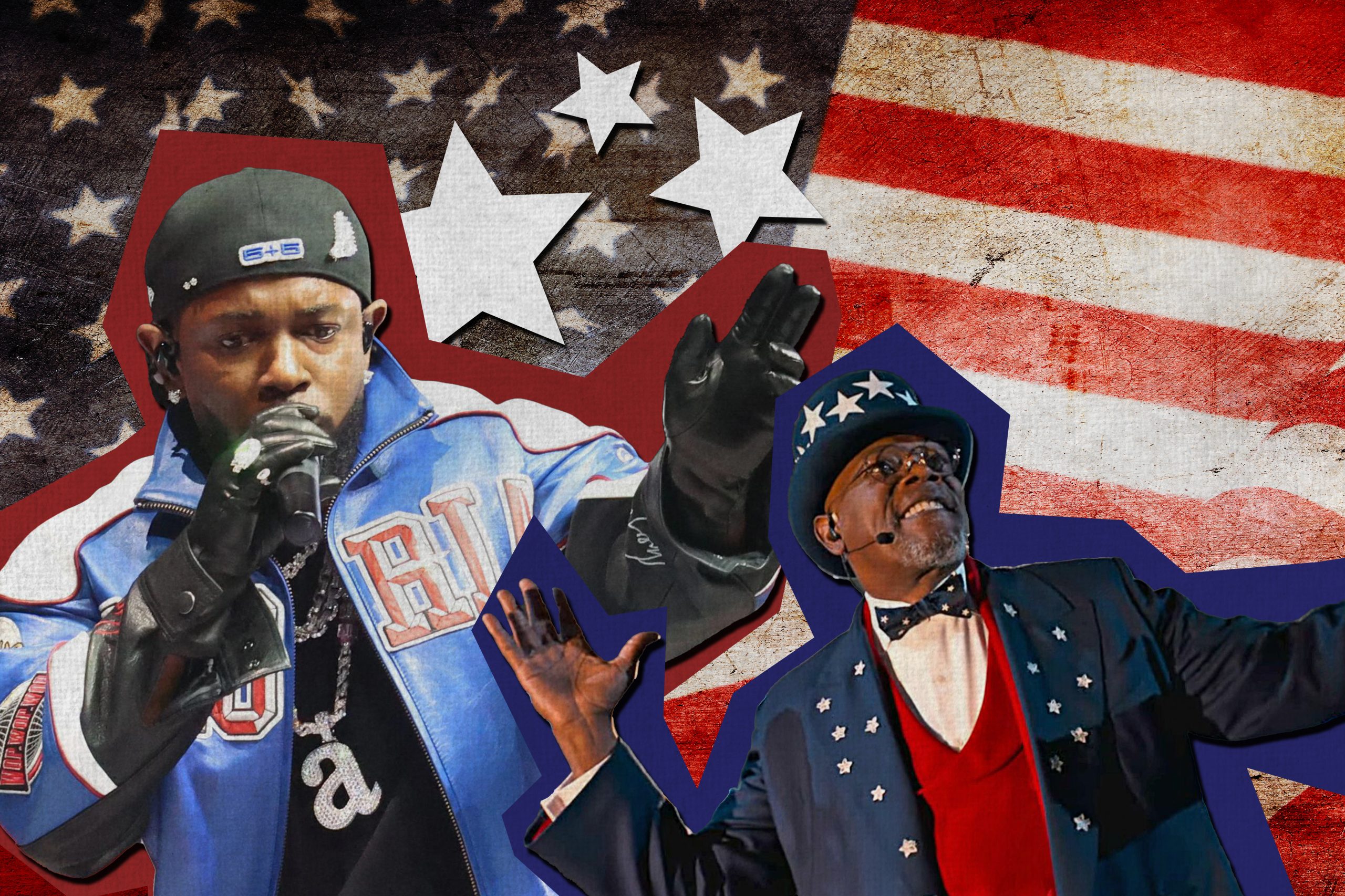
USA Today reported that according to the art director, Shelley Rodgers, the entire performance was framed by a video game theme. The performance opened with a loading screen animation created with programmed lights in the crowd. As it progresses to 100% completion, the symbols used on PlayStation controllers are illuminated, lining the stage. Samuel L. Jackson, or Uncle Sam, pleasantly greets us, saying, “This is the great American game.” A statement that would soon prove to be a double entendre.
We then zoom in on the square where we find Kendrick on top of an old-fashioned Cadillac reciting one of his new songs, “Bodies,” from the album GNX. He ends the song by saying, “The revolution bout to be televised. You picked the right time but the wrong guy”. This was one of the major statements that viewers analyzed. It is a reference to Gil Scott Heron’s 1971 song, The Revolution Will Not Be Televised, which implies that the mainstream will not broadcast systematic change but requires grassroots organization. With President Trump in attendance at this year’s game, many speculated this was some sort of outspoken protest against his re-election. Others, like FD Signifier, a black commentary YouTuber who has himself explained the history of Kendrick and Drake’s beef, came to a different conclusion. Perhaps this is Kendrick’s way of warning the audience, “You expect me to incite a revolution tonight but I’m no savior”.
He moves into “Squabble Up,” a song remixed several times on social media, but is interrupted by Uncle Sam, who proclaims the performance is “too loud, too reckless, too ghetto.” Subsequently, he asks, “Do you really know how to play the game?”. Uncle Sam’s imagery is probably one of the most apparent messages of the night. He is an infamous American figure, originating from Samuel Wilson, a meat packer who supplied the US Army during the War of 1812. Samuel Wilson marked the barrels with “US,” but the soldiers called his food Uncle Sam’s, a nickname he was known by locally. The nickname was then circulated through newspapers and became synonymous with the US government, his likeness most famously seen on WWI propaganda posters.
Uncle Sam, this personification of America, is moderating what Kendrick Lamar, a black man, can perform and say. It’s akin to Childish Gambino’s “This is America”, a piece of work that, among other things, proclaims black people are solely used for entertainment, and if they are to speak out, they are no longer desired by the public. Kendrick Lamar is actively defying that notion by continuing to represent black culture. This becomes most notable when Kendrick stands in front of a light post later in the performance with his male dancers jamming as if they were on a street corner. One dancer shows off his grills as he bobs his head, and another dancer is seen lying atop the post before the camera pans down. They are soon chased off by Uncle Sam, who says, “Bringing your homeboys is a cultural cheat code”.
It’s quite ironic to make Samuel L. Jackson this representation of restrictive American ideals when he has a past of partaking in revolutionary action. During his time at Morehouse, he held Dr. Martin Luther King Sr. hostage to demand the end of discrimination for black school board members and the creation of a consolidated school for black studies. Jackson and other protestors brandished guns as they occupied a building and engaged in a standoff with the school. He was arrested and suspended for two years but was eventually able to return and finish his degree.
His involvement in the black power movement also led to the FBI threatening him and imploring his mom to force him out of Atlanta. In a Rolling Stones interview, he explained, “They told my mother something bad was going to happen to me if she didn’t get me out of Atlanta in the summer of ’69. I’d already decided that I was going to be an actor at that point. I wasn’t out of the Revolution, but I wasn’t going to be the political animal that I had been.” His mom forced him onto a plane to LA, where he became an actor.
Kendrick heeds Uncle Sam’s advice and moves on to perform Humble. His dancers surround him very clearly, creating the American flag. Many were underwhelmed by this symbolism, which simply says, ” Black men made America.” This isn’t a lie, but the expectations for Kendrick Lamar, who has given some of the most politically provocative performances in music history, were definitely higher. Perhaps performing under the banner of the NFL kept him from making a bolder statement on one of the biggest stages.
The tracksuits his dancers wore to create this symbolism might hold a more interesting message though. People online have compared their solid color to prison uniforms. It’s not as concrete of a theory but an interpretation based on the set design and choreographed movement. As he moves on to Euphoria, one of his first Drake diss tracks, he and his dancers stomp across what many have compared to a prison yard. The theory becomes stronger throughout the performance for instance while performing “Peeakabo”, Kendrick and his dancer are closed inside the fenced-off “X” and the militant chereo of “All The Stars”. While it is a harder message to solidly connect to the performance, it wouldn’t be new for Kendrick as he previously commented on the American prison system, the most famous example being his 2016 Grammy performance.
Serena’s crip walk during “Not Like Us” even plays into this overall theme of being unapologetically black. It was a shot at Drake who dated Williams in the past but also a reference to her 2012 Wimbledon victory where she celebrated with the dance. She was heavily criticized for doing so and was accused of promoting gang violence. She, more than a decade later, is freely defying the selective censorship of black culture.
KDot ends his performance with “TV off” assisted by the final appearance of DJ Mustard. Turning the TV off is very closely tied to Gil Scott Heron’s aforementioned song. It is a metaphorical call to action–urging people to focus on what truly matters. In a poetic turn of events just as Kendrick was transitioning from “Not Like Us” to “TV off”, one of his dancers jumped off of the stage, waving a combined “Free Sudan, Free Palestine” flag. He was eventually arrested and banned from future NFL games but it worked as this unplanned, poetic act of protest that perfectly coincided with Kendrick’s song. If people were looking for bolder politics they may not have necessarily received it from Kendrick but it was there, in the background for all those willing to see.
So was Kendrick Lamar’s Superbowl performance profound or boring? I certainly lean in the direction that celebrities will not be our saviors. If you were expecting Kendrick to do radical protest in front of Trump, you might be looking in the wrong places for hope. We shouldn’t need a rap artist to tell us how we should believe and what the best course of action is, we already should know. Although Kendrick is well known for bold political messages, it’s quite possible a national institution as powerful as the NFL would only let him go so far.
It may not have been particularly profound but it certainly wasn’t boring either. There were several times I found myself rewinding to catch moments again like the hype DJ Mustard cameo, Kendrick stomping across the stage while rapping to “Euphoria”, the expected but highly anticipated “Not Like Us” moment. Kendrick is a master lyricist and exceptional artist so even though I didn’t know the majority of the songs, I was still able to appreciate what was being served to me. Ultimately your personal takeaway from it depends on what you desired out of K-Dot’s performance: a revolution, the maintenance of the status quo, or just a good show.