A Baby Left Is a Baby Taken: The Macabre World of the Changeling in “A Midsummer Night’s Dream”

By Matthew Hardwick
A mother wakes mid-morning, the sun glimmering through the shades of her window. She walks to the nursery, moving silently so as to not wake the sleeping baby. With gentle strides, she approaches the wooden crib and peers over the side with a heart full of anticipation. But when she looks down, her child is nowhere to be seen. Instead, a stranger’s face looks up at her. A cruel mimicry of the child she held so dear — a changeling.
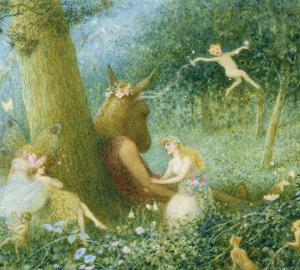
In “A Midsummer Night’s Dream,” often said to be Shakespeare’s most performed play, one such mystery appears. The royal fairy couple, Oberon and Titania, feud over a stolen Indian boy, who is addressed as a “changeling.” They repeatedly argue over who he belongs to and what is to become of him. This is the central conflict in the play for the two fairy aristocrats. But for such an important character, the changeling rarely, if ever, actually appears on stage in productions of the show. Instead, the stolen boy remains cloaked in the shadows. This poses the questions, ”who is the changeling boy,” ”what does he represent,” and ”why does the couple fight so ruthlessly for possession of him?”
The answer lies deep in European myth, shrouded in fable and legend. Folklore scholar Molly Ferguson writes, a changeling is a “fairy that has been left in place of a human, usually a child or young woman, when the human has been abducted into the Otherworld by fairies.” In a modern context, most of these myths would likely be considered quite ableist. These abandoned fairies are often cruelly described as ”deformed or imbecile,” and replace vulnerable children that have stepped outside the bounds of societal norms. In essence, these myths are often used to give reason to why a child may have developmental delays or be disabled.
A number of these myths depict a family seeking to return the original child by either banishing the changeling or excising the fae spirit holding it hostage. Most end in violence. Many changelings are drowned, burned, or even abandoned in the wilderness to be taken back. So why does such a tragic being appear in the comedy of ”A Midsummer Night’s Dream?” The answer is wreathed in the conflict between Oberon and Titania, with a thorny bow of Freudian irony.
Despite being written more than 200 years before Freud’s birth, the story is racked with repressed desires meeting the light of day. Chaos ensues the second the lovers enter the wood: homoeroticism, masochism, bestiality, and more. And that’s before getting into the post-colonial readings of an Indian child, which was likely chosen due to the country’s fantastical and far-off perceptions to a 16th century audience, being abducted, fawned over, and treated as an object.
The play pirouettes through repression, desire, and the societal bounds in the same lackadaisical manner as a child playing with building blocks. Writer Jay McDaniel suggests that sexual desire can be both enticing and thrilling but also dangerous or even violent, and all of it comes out in the forest. He sees it within the play existing at the corona or locus of a character’s awareness. Never do they indulge in such desires, instead they merely flirt with the idea of it. This speaks to the unconscious, but ever-influencing nature of their sexual desires.
Similarly, literary scholar Audrey Robitaillié, speaks about how a changeling, both the imposter and the abductee, exist in a liminal space. The changeling exists both in the real world and the realm of fairies, caught in an ethereal web of existence and non-existence. In this vein, we can see why the boy never makes an on-stage appearance. For him to be present would bring him into reality, making him tactile and real.
Literature scholar and critic Thomas R. Frosch understands the changeling as representative of the conflicting desires of Oberon and Titania. The changeling, for all intents and purposes, is the invisible, repressed conflicting desires between Oberon and Titania. Oberon desires the changeling as a ward and to replace Titania as the main force of influence in the young boy’s life. Titania wants the boy to be with her always, to coddle and protect him from the world itself. In this way, their love for the boy is conflicting and malformed, a dysfunctional family surrounding a hostage of a child.
This is Shakespeare’s masterstroke, a commentary on the unfairness of offloading responsibility onto a child that has been stolen away from a faraway land to be the invisible object of both love and hatred. The cruel world of misplacement was never the fault of the changeling, but in the hands of parents who forged their love around a farce, something that was never here and certainly never there.