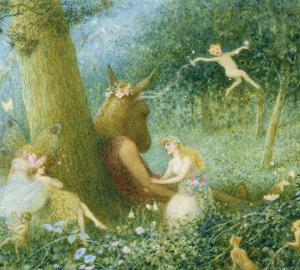
Fanfiction in ”A Midsummer Night’s Dream”

By Lexi Barnett
We’ve all heard of ”A Midsummer Night’s Dream” before. A story of love, drama, and passion topped with a comedic tone. A show that features a chaotic love triangle, quirky characters, and its own play within a play. A passerby on the street seeing an advertisement for the story would likely turn away at a moment’s notice. Not because the play is bad or anything — simply because it feels like fanfiction.
Don’t get me wrong, ”A Midsummer Night’s Dream” is a fantastic play that draws its audience into a world of fantasy, love, and tragedy. It shows how love can blind people into submission and how foolish it can be to only see the good side in those around us. Throughout the play, viewers get a glimpse into the perspectives of Helena, Hermia, Demetrius, Lysander, and even Bottom. However, one question that’s always been on my mind is this: What about the fairies?
Peaseblossom is a fairy who serves Queen Titania along with Mustardseed, Moth, and Cobweb. Their roles are typically glossed over in the show as they only have a handful of lines in the entire play. So what would a story showcasing these fairies look like?
This is where the idea of fanfiction comes in.
Every story you know and love started as an idea from a curious mind. It wasn’t considered fanfiction at the time, but it certainly didn’t get much attention during the first few stages of writing either. It’s even possible that some of these stories never got the chance to be shared with the world. The ones that do get shared become the TV shows, movies, and even plays that we see today. In this sense, we can think of adaptation as a kind of fanfiction.
“A Late Symmer Night’s Battle,” a short story from a book known as “Turn the Other Chick,” is a sequel that features the fairies from “A Midsummer Night’s Dream” in a new light. Written by Laura Frankos, this fantasy world gives a new perspective on Peaseblossom, Mustardseed, and many other fairy characters from the original play. It is a dramatic take on the aftermath of “A Midsummer Night’s Dream,” told from Mustardseed’s perspective. This fantasy world could be considered a work of fanfiction.
Not many people know about “Turn the Other Chick,” but this doesn’t mean that people don’t appreciate other fanfictions based on Shakespeare’s plays. The animated film known as “Gnomeo and Juliet” was obviously inspired by Shakespeare’s well-known tragedy, “Romeo and Juliet.” The film takes place in a garden separated into the Blues and the Reds where garden gnomes Gnomeo and Juliet blossom a forbidden love, just like in the original play. But this isn’t the only film that took inspiration from Shakespeare’s classics.
Disney’s iconic movie “The Lion King” was based on “Hamlet,” a sad story about a prince investigating the murder of his father. The jealous uncle kills his brother and steals his wife, the heartbroken prince finds new comedic allies, and his dead father reappears as a ghost. Coincidence? Whether the plot was intentional or not, the fact is that “The Lion King” isn’t technically considered an original story. Someone reimagined the existing story and added new elements.
Even way back in the day, writers like Shakespeare were driven to write stories from anything that gave them inspiration. Shakespeare’s biggest inspiration came from old stories such as “Ovid’s Metamorphoses,” “Chaucer’s The Canterbury Tales,” and many elements of British folklore. These books contain numerous stories dating all the way back to the late 1500s, including “Pyramus and Thisbe,” which inspired Shakespeare to write “Romeo and Juliet.”
In “A Midsummer Night’s Dream, moments like Bottom turning into an ass were inspired by John Lyly’s “Midas,” in which Midas gets turned into an ass, a transformation based on “Ovid’s Metamorphoses.“ Even this wasn’t the only play that took inspiration from this. Apuleius’ novel “The Golden Ass” had a man that was transformed in the same manner, and yes, a woman fell in love with him. These writers were famous before Shakespeare could even write himself. So this just goes to show that not only did Shakespeare write fanfiction, but that even writers with experience still look back at someone else’s work as inspiration to create a new story.