Katseye is a girl group created from Netflix’s Dream Academy that has exploded over the past year. HYBE, the company that created K-pop groups like BTS and New Jeans, set out to take the Korean trainee model overseas. 120,000 applicants were narrowed down to just six girls who would get the lucky shot to become the next big girl group. Since then, songs like Gnarly went viral on platforms like TikTok, they’ve secured commercials and brand partnerships, and were even nominated for a Grammy.
However, I am not a fan of Katseye. I developed a love-hate relationship with K-pop after 2021 when I noticed the genre I was obsessed with was slowly shifting towards enshittification. Quantity over quality. Profit over authenticity. HYBE, formerly known as BigHit Entertainment, forced BTS to release English singles written by Westerners rather than the previous system, which allowed its own members to collaborate more freely with the label. This stripped my favorite group down to a vehicle of profit despite their members like RM and Suga being incredibly talented writers and producers. BTS reached such heights partially because their own members were writing about their own experiences. When you listened to their music, you knew it was authentic; you knew they were sharing a piece of themselves. But they were forced to give away the best parts of their group, and that was the last straw for me with the increasingly superficial genre of K-pop.
So by the time HYBE was moving into the international market, I was already out of the loop. The American branch of HYBE is in large part managed by the snake-y businessman Scooter Braun, who has a reputation for screwing over artists like Taylor Swift. Expanding their operations allowed them to introduce the unethical, rigorous structure of K-pop to the West.
Katseye’s existence is emblematic of this shift towards enshittification. Their music is nowhere near exceptional. It’s shoddily written and hastily put together, but because of its close association with K-pop, Western fans still eat it up as they do with the slop directly from South Korea. It’s fanfare, not excellence, that has brought Katseye to the heights it has reached, which is of no fault of the girls but a reflection of HYBE’s management. They’re not in this business to lift up new artists; they’re just here to milk them for profit.
Yet despite the vitriol Katseye’s existence invokes within me, seeing some of their members has brought me joy. They all have something that drives you to them, even if you have no connection to their music or never watched Dream Academy. Especially seeing Manon on my timeline brings me so much joy. She reminds me of myself, a cute, stylish black girl who simply wants to succeed. She made an amazing short film that she posted online, further adding to my respect for her as she obviously doesn’t just yearn to be a performer but an artist. Beyond myself, watching someone like her in this position is incredibly important to many black K-pop fans who have long had to put up with racial slurs from group members, colorism, and cultural appropriation. I’m sure for many of them who had to put up with “problematic favs” and these exhausting discussions in the fandom, Manon’s mere existence is a shining light. But I can’t help but feel like her existence as a black girl in this industry is still not a win.
The diversity of Katseye seems to be a means of marketing rather than a mission of inclusion. In the same way, Walmart sold Black Lives Matter merch while funding the police, HYBE is exploiting Manon’s blackness while having no vested interest in protecting her from racism.
Recently, it was announced that Manon would be going on a hiatus due to “health reasons.” She posted her own statement afterwards, which conflicted with HYBE’s. “I’m healthy, I’m okay, and I’m taking care of myself … Sometimes things unfold in ways we don’t fully control, but I’m trusting the bigger picture.” This left many feeling like the only black member was being pushed out of the group.
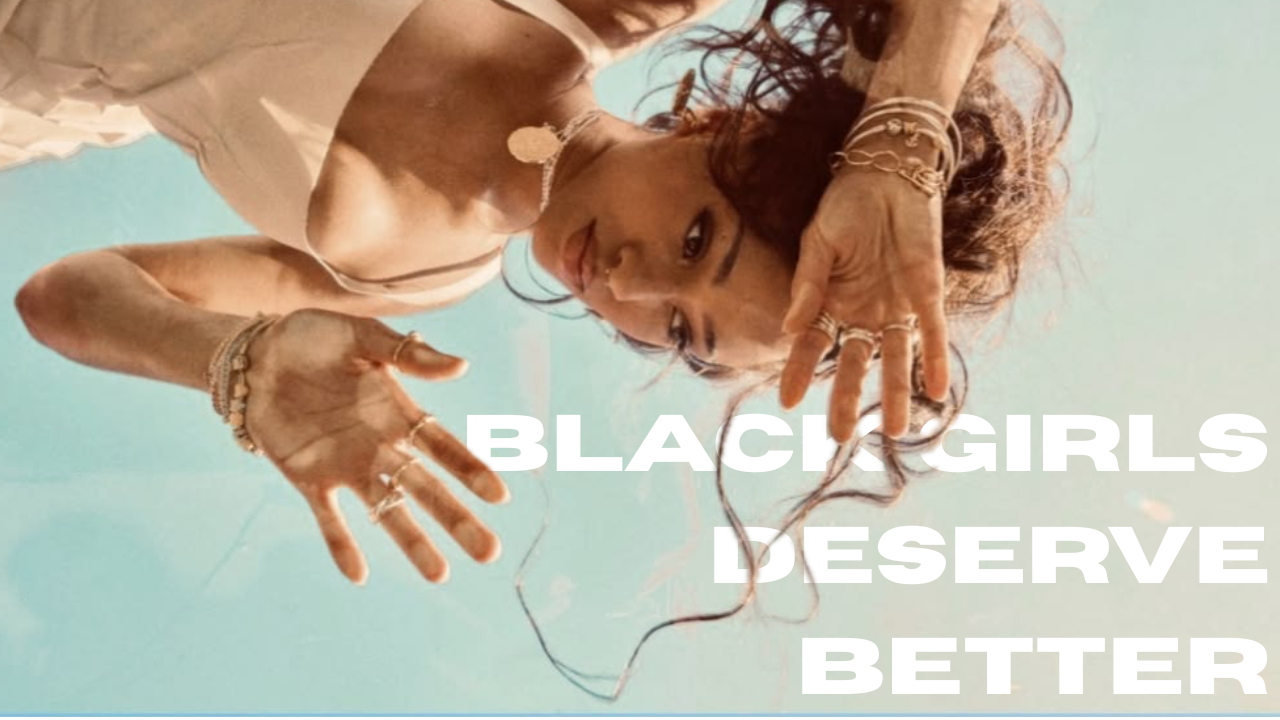
Since Katseye’s debut, she’s been pushed to the back of choreography and excluded from singles. So this “hiatus” feels more like an act of neglect and not a coincidence. Couple this with a history of black girls being mistreated within the music industry, and Manon’s hiatus becomes not just a singular event but a systematic one. One that illustrates the hollowness of corporate “inclusivity”, and that, after nearly thirty years of girl groups, black girls still deserve better.
Since Manon released her statement, members of other girl groups have rallied behind her. They can understand this unique experience like no other – being thrust into the spotlight at a young age and your naivety being taken advantage of. Melody Thornton of the Pussycat Dolls wrote on Instagram, “We see you,” alongside a picture of Manon.
As a black girl who entered this industry decades ago, no one looked after her. She started experiencing panic attacks and developing insecurities, but was afraid that if she spoke up, she would be called lazy or delusional. In an interview with Essence in 2024, she said, “The one thing that I always kept in mind was, ‘You can’t be messing up. You got to keep it together because you are the Black girl. People know that, people see it, and they want to see you win, so you must prevail through any adversity — whatever it looks like.’” This is almost an exact replica of how Manon was targeted online. She was branded as lazy by fans, telling the Cut, “Being called lazy, especially as a Black girl, is not fair. Now I feel like I always need to put in extra work to prove something, even though I really don’t.”
People online have also drawn comparisons between Manon and Normani, the former Fifth Harmony member. She joined the group alongside four other girls who all auditioned separately. It’s clear now, as Normani pursues a solo career, that she has an incredible presence, but while in Fifth Harmony, she was pushed to the back regardless. “I didn’t get to really sing in the group. I felt like I was overlooked,” Normani told Allure in 2021. “That idea has been projected on me. Like, this is your place.”
Normani was constantly reminded of her place as she had to deal with racism from fans and even her fellow members. In 2019, a year after they disbanded, old racist posts from frontrunner Camilla Cabello resurfaced online. Normani responded to these posts in 2020 in an interview with the Rolling Stone: “It was devastating that this came from a place that was supposed to be a safe haven and a sisterhood…they didn’t know how to be there for me the way that I needed it because it wasn’t their own experience, and because when they look at me they don’t see me.”
In the midst of this Katseye controversy, it’s not without notice that Normani followed Manon. She’s shown solidarity with other black girl group members in the past, most notably Leigh-Anne Pinnock of Little Mix in 2020. “I am you and you are me, I see you sis.”
Leigh-Anne followed Manon as well, writing on Instagram, “We need to protect each other.” Leigh-Anne’s story feels like a broken record–yet another example of systematic racism in the music industry. “Constantly feeling like I have to work 10 times harder and longer to mark my place in the group because my talent alone isn’t enough.” She was told to her face by a trainer that, as a black girl, she would have to work harder than the rest of the members.
Keisha Buchanan of Sugababes claimed in 2020 that her record label told her she was “being used as collateral.” She was kicked out of the group back in 2009, and when the first album without her failed, they blamed her. In November, HYBE did the same. They used Manon as a pawn. The company released a merch package with a quiz page tailored to each member. For Manon, one question read, “What does Manon think is her best feature? Her sense of humor, her selfishness, her laziness, or her quiet nature.” Her own company played along with this historically racialized narrative. Merch sales mattered more than their own talent’s well-being.
As mentioned, Katseye’s success is largely built on an image, not a body of exceptional work. This is a strategy that HYBE is betting on, as it has been successful for Korean groups. The image of these girls has been used to get brand partnerships like GAP, Glossier, an Erewhon smoothie, Takis, and even the Filipino chain Jollibee. This inciting image of diversity is boiled down to a marketing strategy.
Even if people like me get very excited seeing people like Manon in these groups, it’s important to recognize the complicated nature of ‘inclusion,’ especially under the system of capitalism. Black people have always wanted to see themselves represented in the media they consume. This has been a conversation long before Katseye was conceived. Our relationship with the media is long and complex, and riddled with a history of being excluded, mocked, and exploited. Black actors for the longest time were only shown as slaves and servants, and this only further pushed pervasive white supremacist narratives. Even when black people started making their own media, they had to bow down to corporate entities to get their projects greenlit. It was a very delicate balance, and if you were deemed “too radical,” like the director Spike Lee, it was nearly impossible to get your films aired. It’s not until recently that black people have been removed as a “brand risk,” and it’s mostly still in watered-down roles like superheroes or Disney princesses, or even in pop culture phenomena like Katseye. It’s progress, but still largely limited in its representation.
It may not be as much of a risk to take on someone with an image like Manon’s, but that calculation is still more about selling a product than protecting the position people like Manon hold. That’s the problem with this system, though. It’s policed by the historic forces that have oppressed black people, so we will never control how and when we are represented on a mass scale.
K-pop and the music group trainee program were built on the backs of black entertainers. Park Jin-young (JYP) credited Motown for inspiring the current system in Korea. Black entertainers also heavily inspired the early look and feel of K-pop through fashion and sound. This is the road that led to the creation of Katseye; despite being an ocean away, all of this is interconnected. Yet what is also interconnected worldwide is a system of taking inspiration from black figures while also throwing them to the waste side, adopting their inventions and consuming their influence while simultaneously exploiting the young black folk who want that same chance to create influence.
Manon’s statement in the Cut about the idea of leaving broke my heart. “When One Direction split, that was really hard,” Bannerman told the Cut. “I don’t want our fans to go through that. I don’t want to be responsible for breaking so many hearts.” She shouldn’t have to carry that weight. There’s no reason this problem within the music industry should still exist.
So it’s hard to draw any other conclusion than this isn’t a coincidence. Manon’s hiatus, Normani’s mistreatment, and Melody’s silent struggle are no coincidence. This is an industry built on white supremacy and a long history of exploiting black people, and it’s continued this way by design. Because of this, HYBE executives will continue to accumulate wealth, while black girls like Manon are treated as collateral, caught in the web of a broken system.