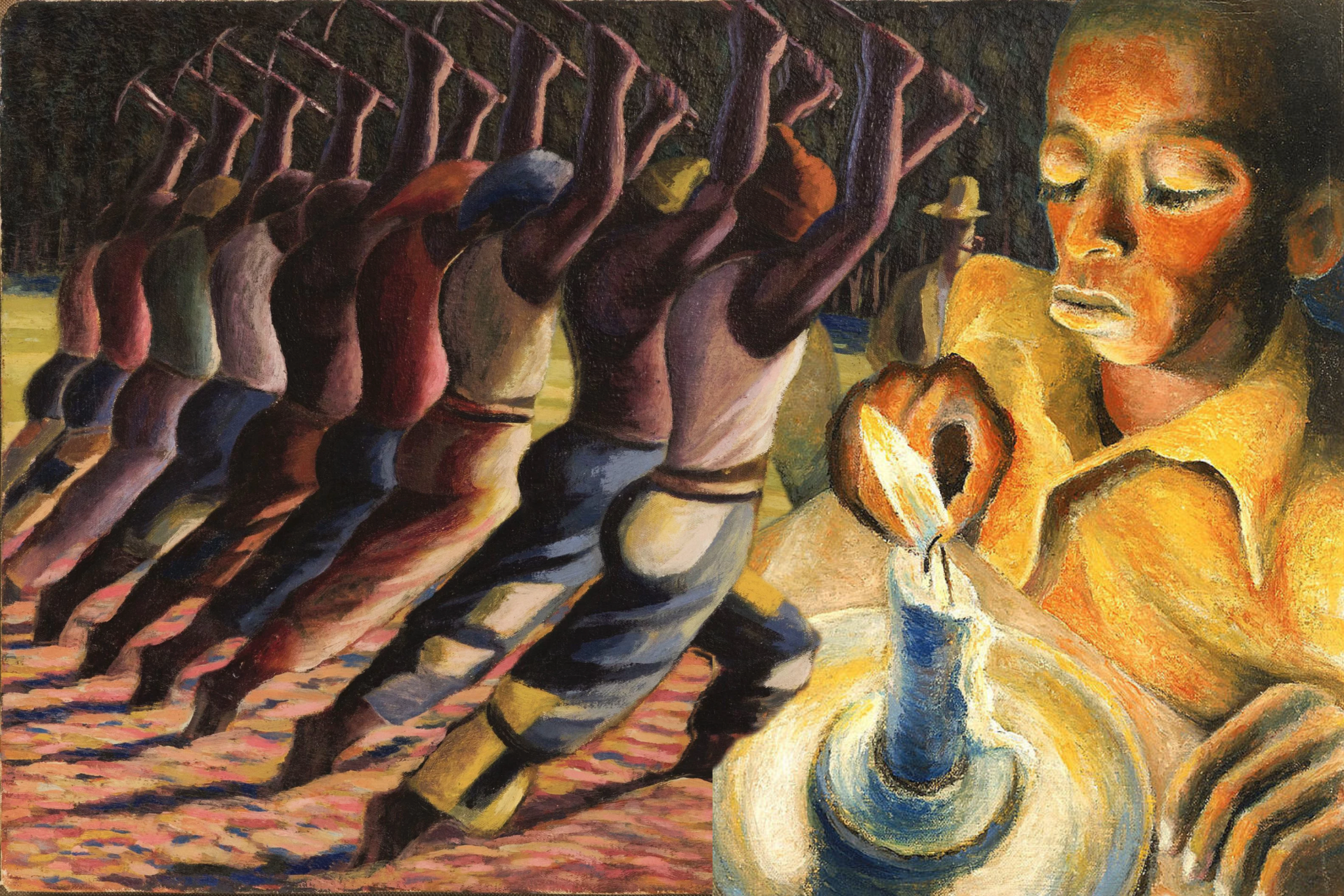
Modern resistance art by activist Favianna Rodriguez
Resistance art is best defined as any art intended to oppose tyrannical holders of power and reject complacency within a society that is not being served by its leaders through the means of creation. It uses underlying critiques to shed light on injustice, whether literal or metaphorical. It is an art form has existed long before it could be labeled or defined. Unfortunately, this art form has been attributed to one of the most historically oppressed groups of people – South Africans.
From 1948 to 1994, the pivotal Apartheid took place in South Africa, detrimentally redefining the lives of many black South Africans. The Apartheid includes many political events and movements in South African history. In their exploration of the Apartheid, the Encyclopedia Britannica defines it as, “the policy that governed relations between the white minority and the non-white majority of South Africa during the 20th century.” Apartheid imposed governing laws on Black South Africans that made them politically and socially inferior to the white minority in the country, who were largely immigrants.
Although white-on-Black oppression had been prevalent prior to the Apartheid, it was during this period that the brutality and injustice became too loud to drown out for many Black South Africans. The two main organizations formed in response to this treatment were the Pan-African Congress (PAC) and the African National Congress (ANC). Each faction had a different idea of what justice looked like, but when the police violence reached its peak during the Sharpeville Massacre and the Soweto Uprising, all Black South Africans knew it was time to stand together against the hatred they were all facing as a people.
In Sharpeville, South Africa, on March 21, 1960, when 5,000 Black South Africans joined together representing the Pan-Africanist movement to peacefully protest the issues that they had with the white governing body, the police came through and ruled that these innocent protesters were out of line and took matters into their own hands. According to the Canadian Museum of Human Rights, “thousands of South Africans marched to the Sharpeville police station. They gathered in peaceful defiance, refusing to carry their pass books.” An estimated 69 innocent protesters were killed because of unwarranted police brutality, rationalized by the idea that black people in South Africa did not deserve free speech rights.
Following that, the Soweto Uprising occurred on June 16, 1976, when a group of schoolchildren protested against the government, and again, the police showed them no mercy. In the official South African historical website’s article “16 June 1976–Soweto Uprising” the author writes, “On 16 June 1976 between 3,000 and 10,000 students mobilized by the South African Students Movement’s Action Committee supported by the BCM marched peacefully to demonstrate and protest against the government’s directive… On their pathway they were met by heavily armed police who fired teargas and later live ammunition on demonstrating students.” The unwarranted deaths of these schoolchildren have been identified as one of the most impactful breaking points for Black South Africans. In spite of this bloodshed, which resulted in a multitude of lives being cut short in their youth, beauty was born from the pain through the subsequent blossoming of resistance art in South Africa.
For many South Africans, resistance art was a way to honor those who had died in the struggle for freedom, and represent the oppression that so many went through in a way that was both full of protest, and in a form that would not put them at the hands of brutality. Through resistance art, new pioneers emerged, and they would later be heralded as some of the most influential artistic representatives of South Africa. Ernest Mancoba, Gerard Sekoto, and Dumile Feni were artists that brought their own perspectives to the oppression taking place in South Africa, and navigated them in different artistic styles and mediums.
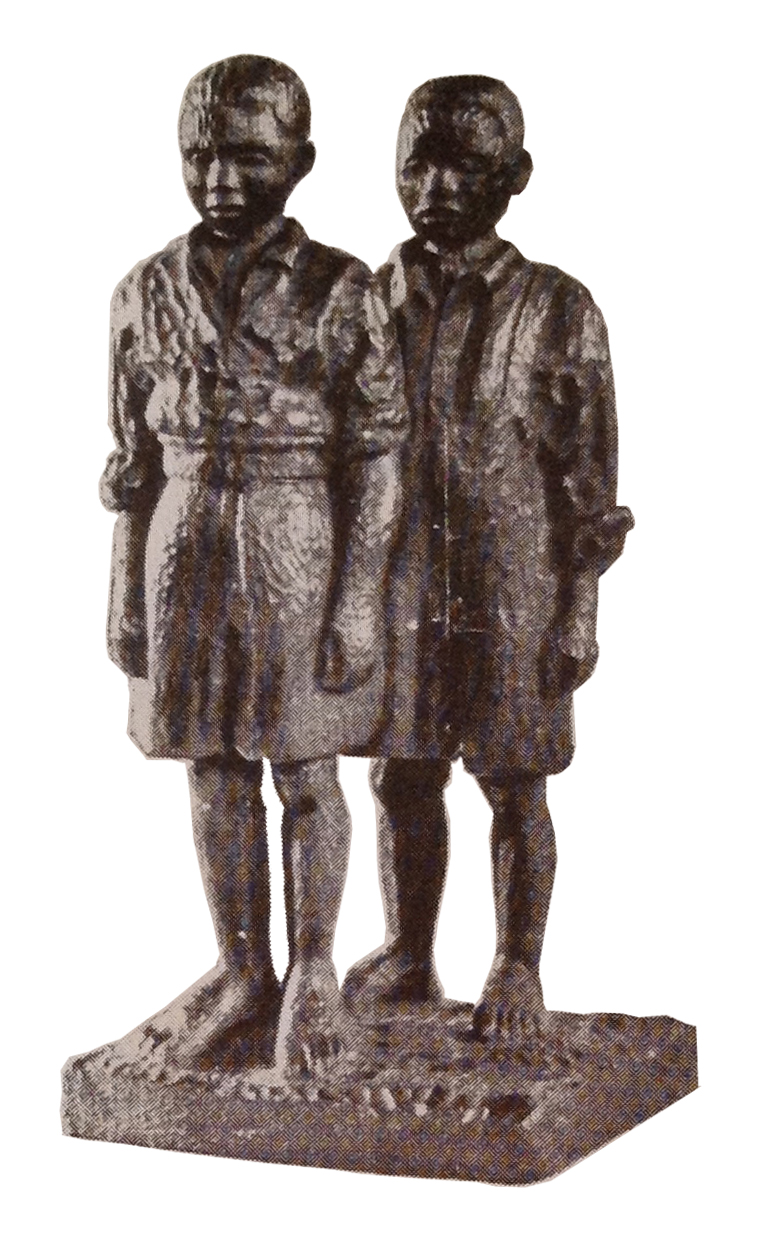
Ernest Mancoba, “Future Africa,” 1934, wood sculpture, unknown size; unknown collection; image source: E. Miles
Of these three artists, Ernest Mancoba was the first to face the detrimental effects of the Apartheid. Born on Aug. 29, 1904, Mancoba enjoyed creating art from a young age as a form of self-expression. As he began to get older, the limitations on what he could do or who he could become as a Black South African that the white governing regime placed on him became clearer, and with that, the choice of whether to stay and endure, or flee in order to create art freely. The Art Institute of Chicago, which holds many of his paintings today, recounts that Mancoba ultimately decided to “flee South Africa in 1938 to study at the École Nationale Supérieure des Arts Décoratifs in Paris.” Granted that Mancoba did leave South Africa just before the start of apartheid in 1948, he still never forgot his roots and the suffering that he saw Black people face at the hands of white ethnic nationalist groups rising up, which influenced him to leave his homeland in the first place. The Art Institute of Chicago further explains that it was there in Europe that Mancoba’s art really began to thrive, likely because he was not held back by fear. The article writes, “Mancoba considered the division between abstraction and figuration to have ‘no real place, no significance, for the African artist, just as it never did for the European artist’,” and one can see this in some of his artwork inspired by news of the Apartheid that reached him even in Denmark where he settled.
One of Mancoba’s most famous pieces, a wooden sculpture titled “Future Africa” (1934), depicted in both abstraction and figuration what Mancoba envisioned of children in Africa, even before the Soweto Uprising in 1970. “Future Africa”, portrays two Black children with their eyes cast mournfully to the ground, heads bowed as if forced, stiffly holding both hands clenched at their sides. We also see excavations at the base of the wooden sculpture, which look like the footprints of their predecessors that they are painstakingly getting ready to step into. Mancoba included these prints as a representation of the cycle of submission that Africans were being placed into generation after generation in South Africa, and how they were being forced to accept the life of inferiority that the white government wanted them to have. Huddled together, the two boys are coming to terms with their fates that are seemingly unchangeable and, as a result, deeply painful. “Future Africa” captures the tone of hopelessness that plagued so many Black South Africans during the peak of the Apartheid, and thus, is classified as one of the earliest resistance artworks.
Mancoba wrote about the sadness his works evoked through their depiction of the modern suffering of Africans when placed alongside other African artworks on display in Europe. The Museum of Modern Art’s sister website, Post: Notes on Art in a Global Context, reports, “It is nonetheless pertinent that Future Africa became ‘sad’ once Mancoba stood appreciating African art in the British Museum in 1938. Quitting South Africa must have yielded a new perspective, and Future Africa betrays desolation upon closer inspection: the boys’ heads are bowed, their eyes downcast, their postures resigned. On a formal level, too, Future Africa arguably undermines its own emancipatory message by failing to break free of colonially imposed academicism.” Surrounded by carvings and paintings in the British Museum portraying freedom, beauty, and strength through the lens of Africans, Mancoba’s art was the antithesis of the works around it, representing a dispirited attitude towards breaking free of the detrimental cycle of succumbing to white rule. Still, artworks like this came to define South African resistance art, not only because of Mancoba’s location in South Africa when he made it and his South African heritage, but because of the fact that the sculptures correspond to a shared feeling throughout Africa and a silent call for better treatment for Black people. Mancoba, unintentionally, began the movement of resistance art with “Future Africa,” and he would later be placed alongside artists like Gerald Sekoto, who took the pain and suffering initially evoked by Mancoba’s work a step further.
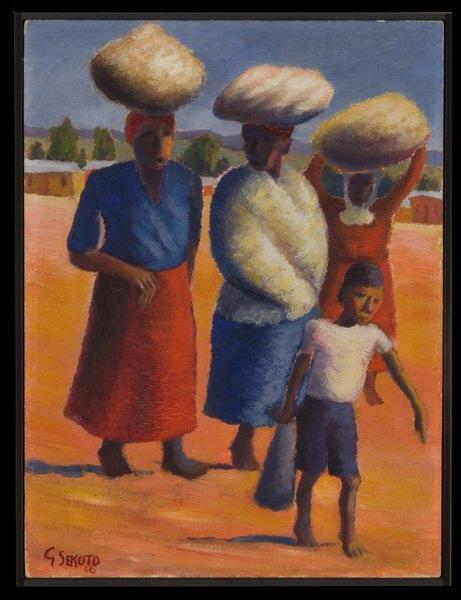
Gerard Sekoto, “Women and Child,” 1946, Oil on Board, Collection Unknown
Born nine years after Mancoba in 1913, Gerard Sekoto was another South African resistance artist and musician. Raised in Botshebelo, South Africa, Gerard Sekoto came from a Christian missionary family. Growing up, Sekoto’s family was lower-middle class, but they encouraged their son to be resourceful in pursuing his desire to create art. The Lillian Gray School of Art and Fine Art published an article recounting Sekoto’s early life, saying, “Sekoto was drawn to art from the start… He often modelled clay from the river bed to practice sculpture. To practice drawing, Sekoto used a slate.” Living during a time when art supplies were not readily available for Black artists, and being that the occupation as a whole was thought to be impossible for Black South Africans, Sekoto had to be remarkably resourceful in developing his art skills. Having little to no supplies, he learned to rely on his environment when sourcing his art materials. Because Sekoto’s only means for drawing was on a slate, many of his earliest pieces and inspiration were lost to time. As he got older, he began to look to his environment for inspiration the same way that he learned to rely on his environment for supplies, which became the catalyst for him to become a resistance artist.
Once he was finally able to buy supplies as a young adult, some of his earliest paintings depicted family life and relations on the farm he grew up on, with his relatives as his subjects. In early pieces like “Women and Child,” an oil painting Sekoto made in 1946, his subjects appear as hardworking farmhand women getting things done in the sun alongside a child with a tired expression, likely from having to work all day. This work’s art style, classified as social realism, highlights what life was like day-to-day during Sekoto’s life, before the complete takeover of the Apartheid. Although working in the sun throughout the day is not considered ideal by many, the field was a place where many Black South Africans developed deep friendships while talking to pass the time and, together, grew as a people, farming to share and trade between families. Works like these captured the serenity of life in the country, away from the grips of apartheid and the basis of the white minority rule.
With the rising tensions in South Africa and the effects of apartheid becoming more apparent, Sekoto decided to become a teacher. As the Lillian Grey article recounts, “[There] he discovered coloured pencils for the first time in his life. Sekoto was awarded first prize for designing a badge for his school’s blazer and was rewarded with a bible and five shillings. This was the first time that Sekoto learned that art could make him money.” Finally recognized by his peers on a broader scale in South Africa, he was able to create even more artworks and become even more specific in his subjects’ external turmoil and in capturing the suffering of the people in the environment of apartheid-ridden South Africa. When he moved away from the farm in 1938, and into exile in Europe in 1947 to escape the growing racial segregation, Gerard Sekoto began to create even more pivotal pieces of resistance art.
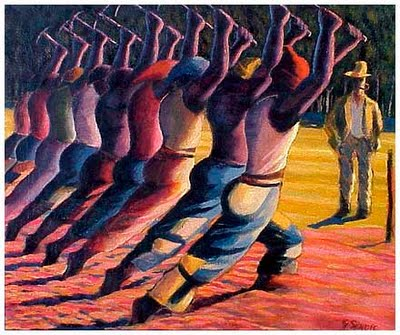
Gerard Sekoto, “Song of the Pick,” 1947, Oil on Board, Collection and Source: Iziko South African National Gallery
While studying in Europe, Sekoto was moved by art’s ability to evoke feelings in viewers by capturing real hardship, such as in Mancoba’s work. We see the influence of both Mancoba and Van Gogh in one of Sekoto’s most famous pieces of resistance art, titled “Song of the Pick”. As a powerful narrative painting, “Song of the Pick” gives yet another perspective on farm life, this time not the homely, warm environment Sekoto knew when growing up. In this oil-on-board artwork, in rich, bright colors with an extravagantly repetitive composition, viewers see a line of nearly identical Black South Africans, synced and hard at work with picks in their hands, tilling the soil ahead of them. These figures’ faces never meet the viewer’s eyes, and the only feature that differentiates them is the color of their clothes. Conversely, the main element uniting them is their skin color. In the distance, one can see a white officer smoking a cigar, watching these men work, representing the white minority in South Africa that was operating during the Apartheid in the most oppressive ways possible. The facelessness of the Black characters combined with the unapologetic expression of the white officer is both a commentary on people being stripped of their identity to break them down and on the harsh fate faced by the masses of Black South Africans in the Apartheid.
Still, though, a sense of unity is evoked from the piece as these people work towards a common goal and towards freedom, instead of standing alone. As told by O’Leary, “the black labourers appear in a position of strength, with their harmonized and free-swinging axes, compared to the white guard who stands alone.” This perspective adds a beautiful touch to a work made in such a dark time. From the ashes, hope rises through the harmony and togetherness of Black South Africans in the narrative. Sekoto brought new perspective to resistance art, reflecting the truth while also insinuating new, hopeful promises. Although he died in 1993 and would never live to see the end of Apartheid, his works imply that he always believed in a brighter future and strength in unity, even in dark times. Through creating works that challenged the political regime while also inspiring hope, Sekoto secured his place as a famous resistance artist and now has a large collection of his works in Johannesburg Art Gallery in South Africa, bringing him back to where hope was born for him through art.
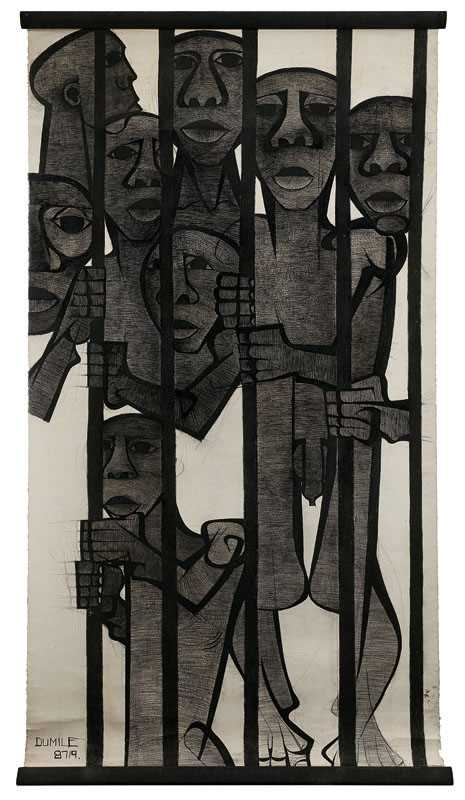
Dumile Feni, Children under Apartheid, 1987, Charcoal, collection unknown, source: Aspire Art Appraisals
Both resistance artists, George Mancoba and Gerard Sekoto, favored portraying the struggles of apartheid through artworks that were not forthrightly dark or sinister on initial viewing. The meaning behind many of their pieces is what embodied the tone of melancholy in their artwork. On the other hand, when artist Dumile Feni’s works began to circulate as resistance art, they changed the game by introducing depictions of Apartheid life with overtly dark undertones – literally in their colors, in their erratic stroke work, and in their human representations. Born in 1942, and raised during the start of Apartheid, Feni witnessed and lived through many horrific events like the Sharpsville Massacre and the Soweto Uprising, and these events were catalytic in his artistic journey. Feni was not afraid to create works that would disturb anyone complacent about what was happening in South Africa.
Aspire Art, a renowned art auctioning website, expands on this idea, referencing one of Feni’s most jaw-dropping works, “Children under Apartheid,” “Feni devoted his life and his art to the struggle for freedom. The artist spoke out internationally against the “degradation and enslavement of his people.”” Feni’s works, like “Children under Apartheid,” compel viewers to come face to face with the harsh reality of Apartheid. The children depicted in this charcoal work are drawn suffering, hopelessly clinging to bars with an iron grip – likely with the last amount of strength they have after the unimaginable hardship that they’ve experienced. The deepest sorrow and misery paint their faces as they look poignantly at the viewer. One has no choice but to sit and feel their sorrow when looking at the work. Quotes by Feni convey that not only was he a fearless advocate for the end of apartheid, but also an unapologetic political artist. Given how long and relentlessly he worked to show people the reality of the oppression Black South Africans faced, he perhaps best fits the modern definition of a resistance artist. As the last and most famous of the Apartheid resistance artists, Feni encapsulated the core purpose and message of resistance art. Feni does not whitewash the dark reality faced by so many, using overtly dark tones to appeal to the viewer’s conscience.
Ultimately, resistance art created a way for Black people to communicate their woes without having to put themselves at the barrel of the gun of the oppressor that forced them into compliance by stripping them of free speech and protest rights.
Across all these artists’ works, the main focus is always the same, and that focus is always the figures – the people. We see Black South African people with melancholic faces, artistic representations of the real suffering happening at the time of the works’ creation; we see them yearning, and we see them working, all for the same thing: freedom. They capture the tone of hopelessness that plagued many Black South Africans during the Apartheid. Resistance art captures the spirit of a longing for freedom, whatever that may mean for the individual, and the silent cry of hope for a brighter future. Artistic and cultural South African figures like George Mancoba, Gerard Sekoto, and Dumile Feni each brought a different color to their approaches to the Apartheid and its effects on South African youth. Because of artists like them that used their work to provide insight into some of Africa’s darkest times, today we not only gain insight into history, we also see the power of creation and the beauty it brings to some of the ugliest situations. Knowing that Dr. Martin Luther King Jr. also spoke in his 1964 “Civil Rights, Segregation, and Apartheid in South Africa” reflection speech, remarking that South Africa was home to the “world’s worst racism,” it can be difficult to see how these artists were able to draw light out of such profound darkness in a way that did not involve hate or war. “Future Africa,” “Song of the Pick” and “Children Under Apartheid” are not only visual testaments to the pain of South African peoples, but also the foundation for resistance art even to the present.
Today, we must honor South African resistance artists for their lack of fear and proclivity for truth in creating the works that were pivotal in building protest art even in today’s world. Although the Apartheid has long come to an end, our world is still imperfect – tyrannical rulers take the form of presidents, innocent children die in wars they have no effect on, and racial injustice is still tearing families apart. These resistance works remind us that with empathy, understanding, and an unwavering desire for positive change, dark times can pass, and hope can come again.