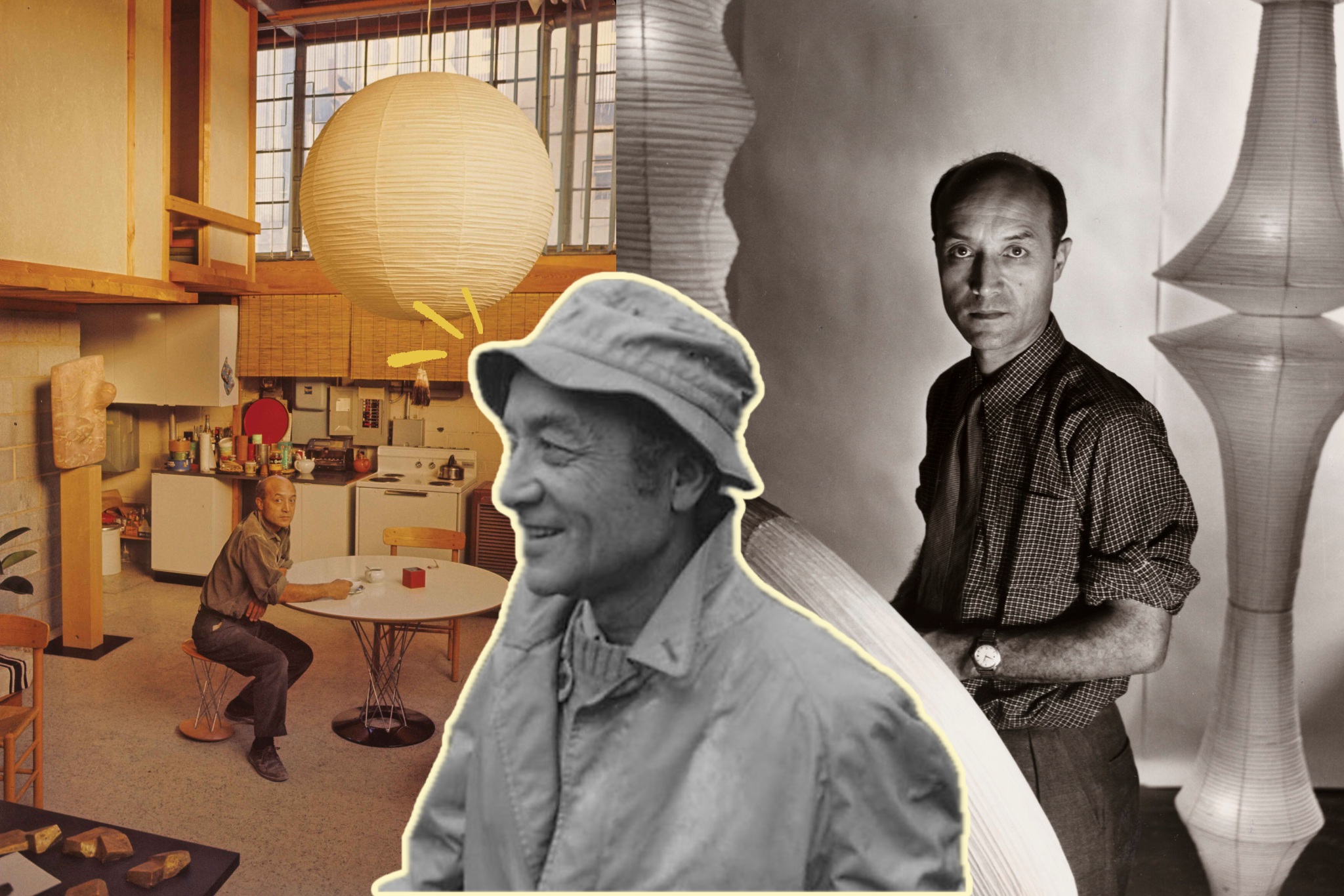
In 1964, Japanese American Artist Isamu Noguchi described his role in the art world with this statement, which would resist categorizing his work within a single discipline for its process and reflection of his working methods.
Today, archivists, historians, and museums widely regard Noguchi as an artist, but his work reveals a strong connection between art and design, both of which he understood deeply. He used this knowledge to create unique sculptures, home décor, and even playgrounds that show how a work is sometimes more about the experience rather than just what you see. He created everyday items through the lens of an artist. This past April, the High Museum of Art invited visitors to experience Noguchi’s work in a new retrospective exhibit called “Isamu Noguchi: I am not a designer.”
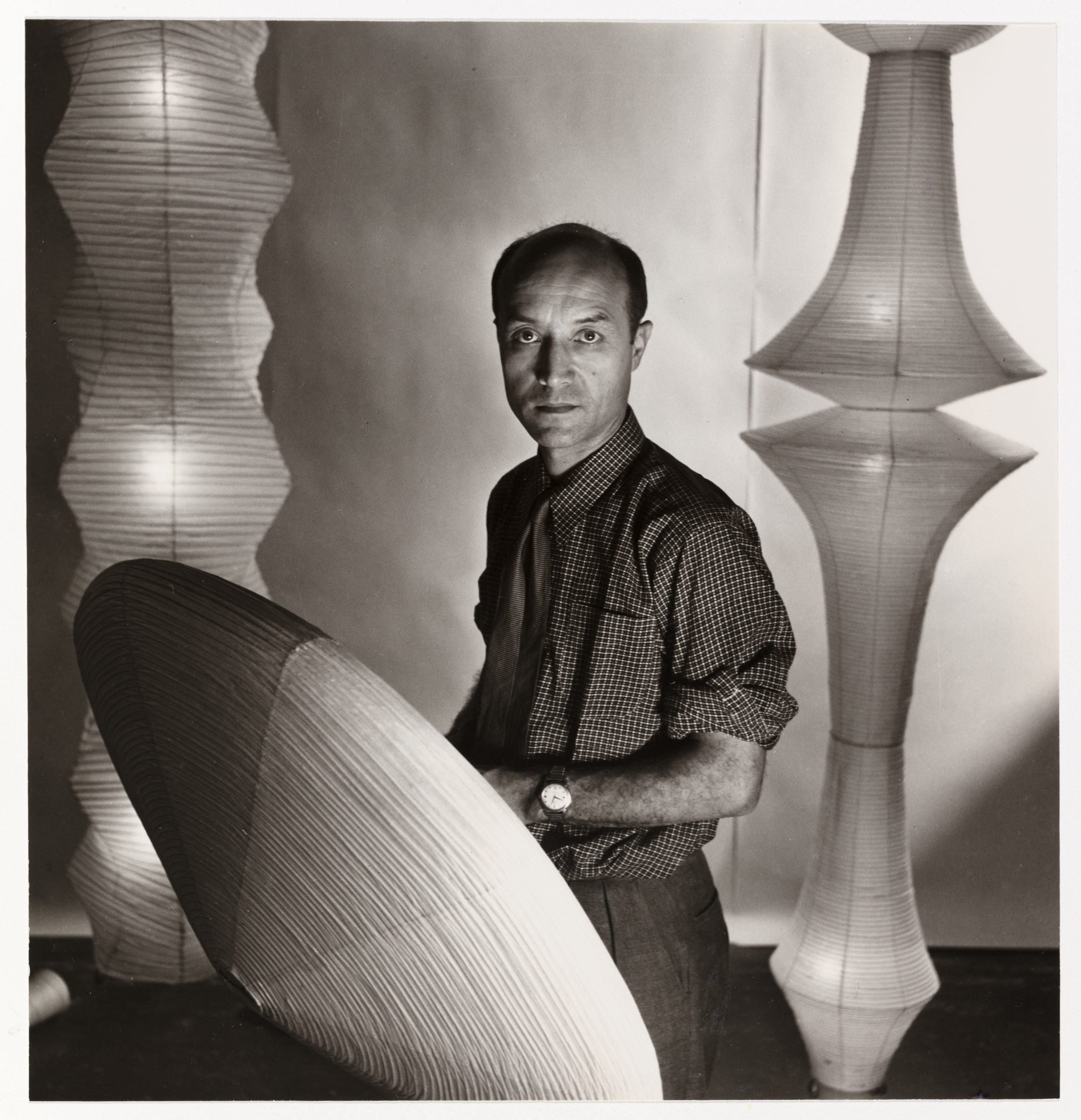
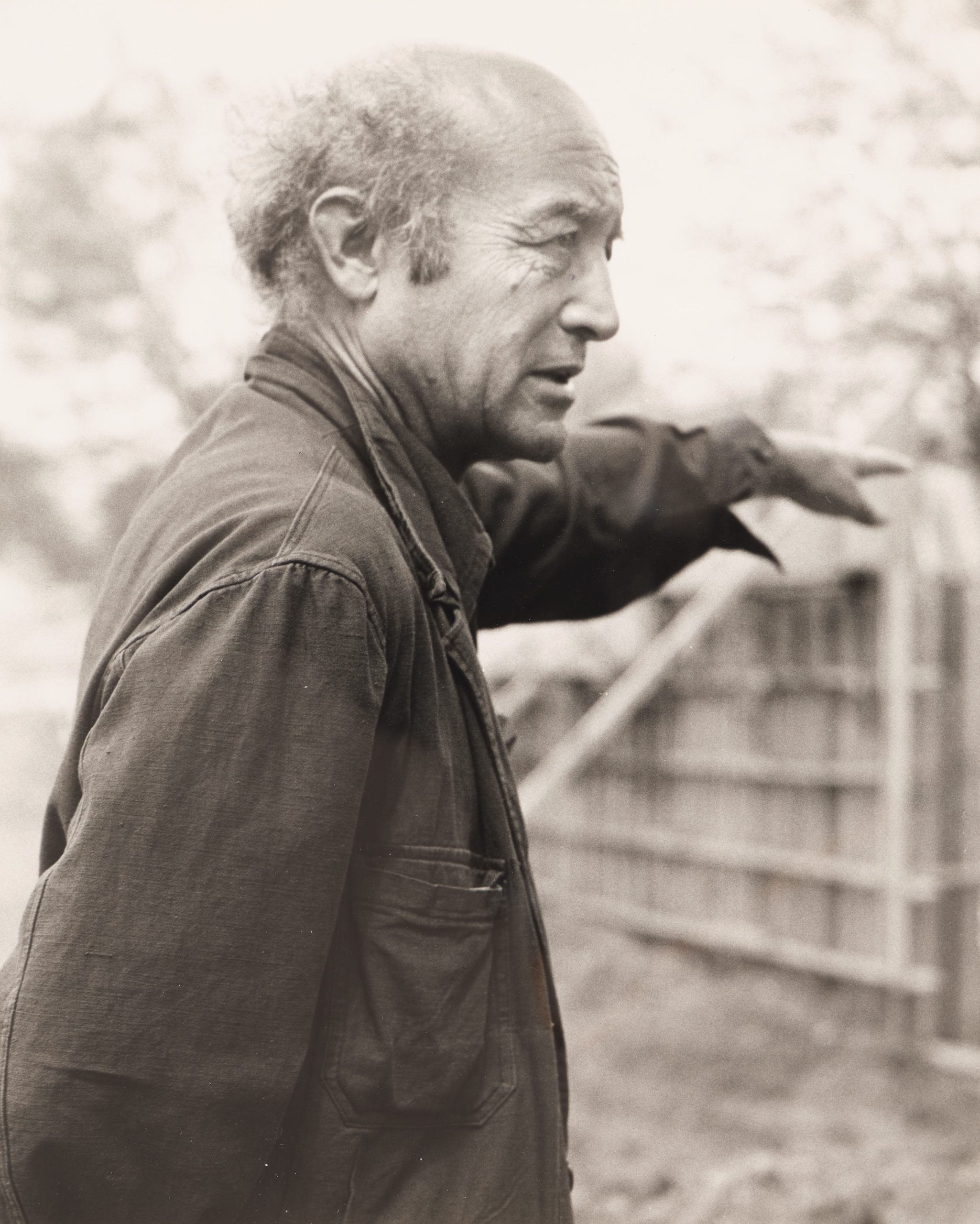
Photo courtesy of the High Museum, shared by Marci Davis (Woodruff Arts Center) ‘Louise Dahl-Wolfe, Isamu Noguchi’
Noguchi’s pieces were not unique because they were hard to find—many, like his Radio Nurse table from 1937, were produced and sold around the world. Instead, they were unique because he saw them as useful objects that combined style and function. One example of his approach to making multiples is the first sculpture you see in the exhibit, Song of the Bird (1958). This piece started as a model and was later made into a sculpture for a New York City courtyard. Noguchi said he was not a designer, but many works in the exhibit suggested otherwise. The way Song of the Bird began as a model shows he thought of it as part of a larger whole, much like a designer would. This sculpture, on loan for the first time, is made of Imperial red Swedish granite and Greek marble, shaped into geometric triangles and diamond forms that look like birds’ heads stacked in a line, showing rhythm and movement in stone. In the same gallery, there is a photo of Noguchi looking into what would have been a model workspace, facing the viewer. This is the first and one of the very few times that visitors see his face in the exhibit, as the rest of the show focuses on how he lives on through his art and iconic works like Song of the Bird.
Even Song of the Bird, as special as it was, had another version made by Noguchi in 1952, using a different stone but the same geometric shapes. Sculptures like this appear throughout the exhibit, creating a kind of “scavenger hunt” for visitors, as the curators describe it. Unlike many artists of his time, Noguchi was not bothered by making multiples. He produced many of these works between 1948 and 1965 in both America and Japan. In the fine arts, especially in America, a piece is often seen as more valuable if it is one of a kind, but Noguchi, who lived between two cultures, saw art’s value differently. He explained this in a newspaper, which is on display in the Making Multiples section of the exhibit.
“Here in America, it’s a different background… we’ve got all the facilities for machine manufacture. And an artist who doesn’t take advantage of this is just a fool!” Noguchi said in a press interview.
Then followed the epiphany:
“Here, we suddenly realized, was a man who was really the product of two cultures, two backgrounds, two distinctly different ways of life. And each was right. And each was separate from the other.”
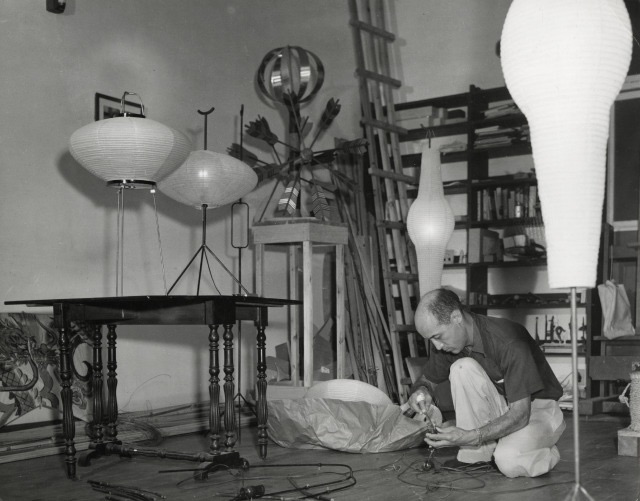
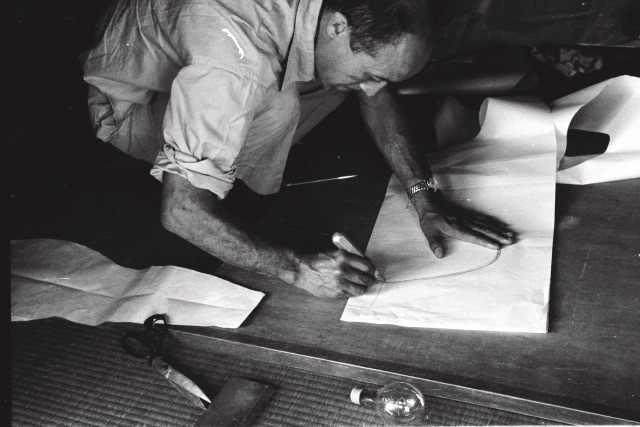
Photo courtesy of the High Museum, shared by Marci Davis (Woodruff Arts Center) ‘Noguchi Assembling Lamp’
As a Japanese American, Noguchi often said he felt both inside and outside the worlds where he made art. He had a strong cultural connection to Japan, which influenced his work and the materials he chose. This connection is especially clear in his famous “akari” light fixtures, which he made only in Japan. The exhibit in the High Museum featured akari in many shapes, sizes, and textures. Some had spiral designs that drew your eyes down, and others were folded, crinkled lamps that looked like floating boxes on the ceiling. These specific museum akari were made especially for the exhibit, and each has its own story. When Noguchi gained worldwide fame for his design work, he was invited to show his art in Europe alongside marble sculptures of people and goddesses. Many people criticized his akari for being ‘too simple, plain and not nearly as complex’ as the marble works, which confused him. For Noguchi, these lanterns were reminders of his Japanese heritage, and their craftsmanship gave them value. He called his akari ‘light sculptures’ because they used light to create form and movement, just as a sculptor shapes marble to show movement and detail. Noguchi’s playful approach to light did not end with akari; they were one of his most personal creations, but he also explored light in his larger designs, like his set pieces.
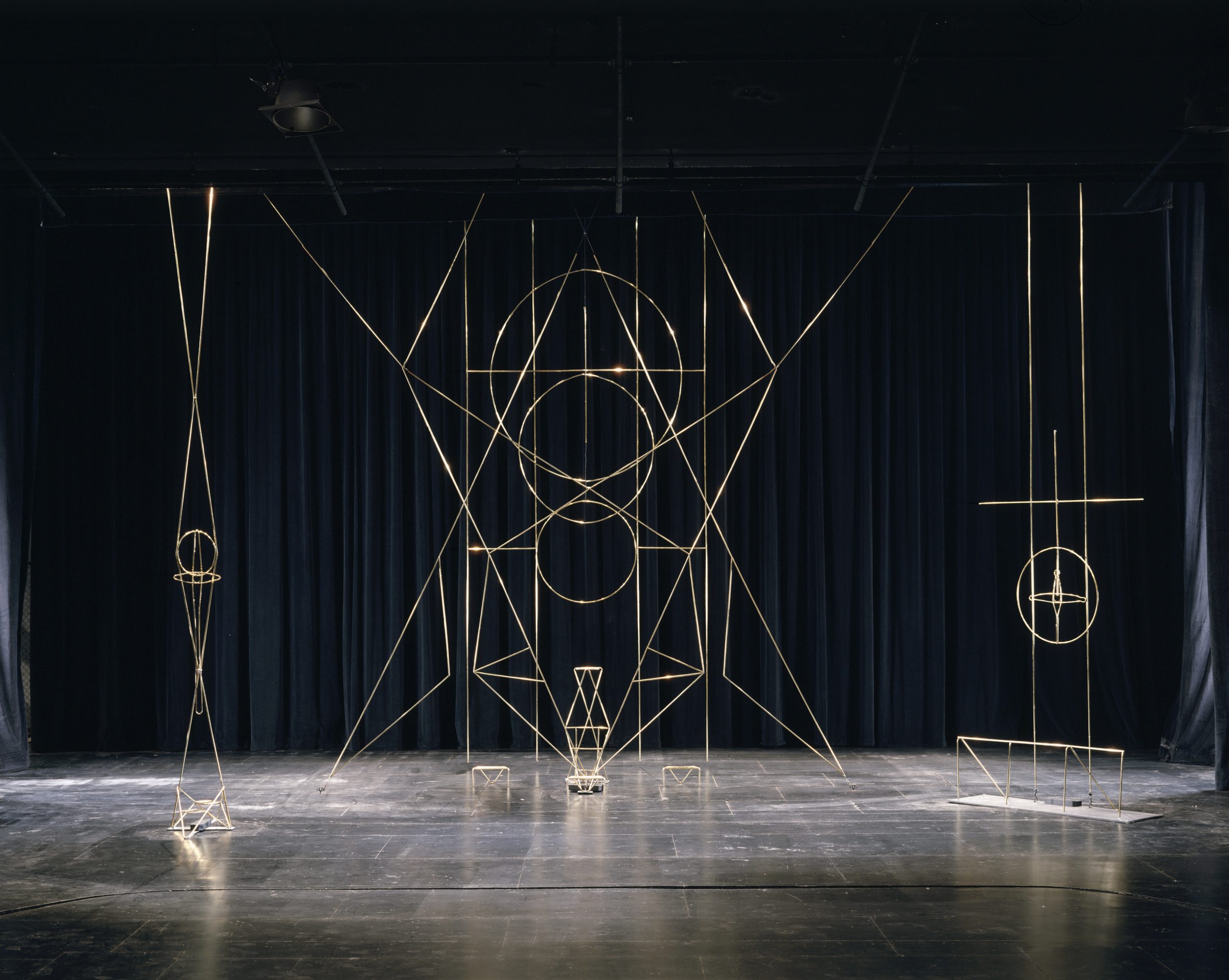
Photo courtesy of the High Museum, shared by Marci Davis (Woodruff Arts Center) ‘Noguchi, Seraphic Dialogue’
Noguchi was talented in many areas, creating sculptures, architecture, set designs, furniture, play spaces, and even landscapes. He designed many set pieces, including his metal arrow prop for Stephen Acrobat, a circus-like dance performance, and one of his most impressive uses of light, the stage prop Seraphic Dialogue (1955). Seraphic Dialogue inspires appreciation for how a designer’s attention to detail and new ideas can transform a space. Made of brass rods and steel wire, this prop was created for a play about Joan of Arc and uses light to enhance both the scene and the mood. Noguchi’s personal notes that were shown in the exhibit reveal how important lighting was to his designs:
“This set is only effective with lights–moods to be varied by changing intensities between the various elements.”
With this golden structure, viewers see how shapes and light work together, showing key design principles. Yet, Noguchi still did not call himself a designer. Examining pieces like “Seraphic Dialogue,” you realize how much thought Noguchi put into both art and design, even if he did not see himself that way.
Photo courtesy of the High Museum, shared by Marci Davis (Woodruff Arts Center) ‘Noguchi, Floating Lunar (light plaque)’
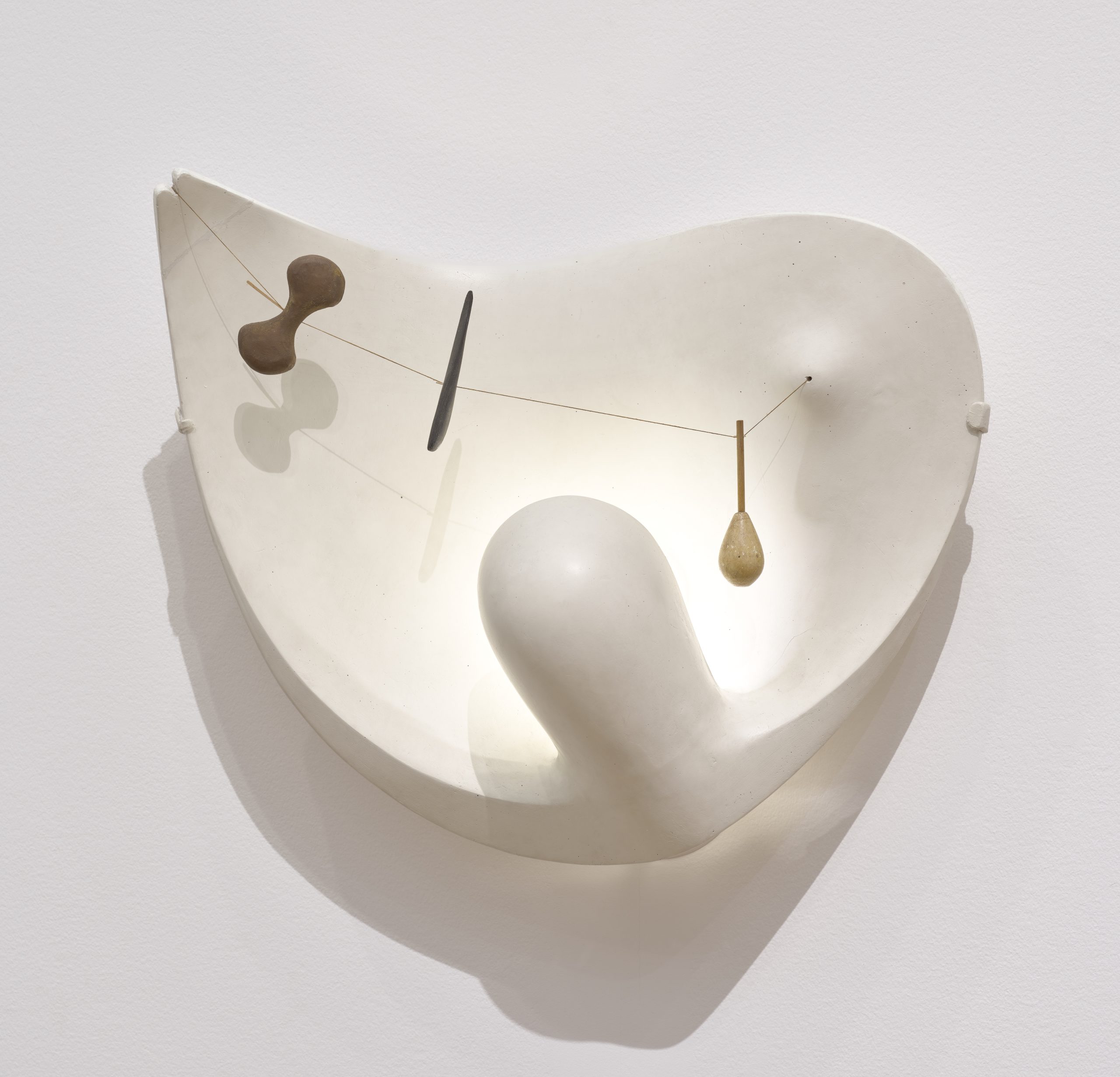
Both the akari and “Seraphic Dialogue” were design experiments where Noguchi used light to tell new kinds of stories. Whether he was creating a space for a character like Joan of Arc or using light to add movement and brightness, Noguchi always designed with a purpose beyond just looks. As you walk through the exhibit, you see that his work is more than it first appears, with plans and sketches showing how he developed and experimented with different ideas. For example, Noguchi created a new type of lighting called Lunars, which looks very different from his akari. He made these Lunars while living on the East Coast of the United States, and you can see them in the museum’s Shaping Spaces section. The High Museum commented on how the Lunar designs play with shapes and light:
“‘Light sculptures’ resulted in a series of mixed-media bas-reliefs he called Lunars. Many of these make use of magnesite, a cementing material commonly used in construction. The artist-designer found magnesite’s cake batter–like consistency perfect for hiding the Lunars’ built-in light beneath undulating, biomorphic curves.”
With his Lunars, Noguchi once again turned light into a key design element, bringing life to his work. While working in Japan, he used only granite or basalt, choosing materials that reflected his connection to the place. Later, as a curator of his own exhibitions, he learned to balance heavy stone pieces with the lightness of akari, showing his deep understanding of design principles even though he did not call himself a designer.
Photo courtesy of the High Museum, shared by Marci Davis (Woodruff Arts Center) ‘Noguchi Sketching’
Behind Noguchi’s finished works was a careful process of developing his ideas. That’s why the High Museum displays his sketches of both completed and unfinished projects. These behind-the-scenes works show his attention to even the smallest details, with notes and markings that explain what he could not capture in drawings. Noguchi often worked with others, especially on projects like “Seraphic Dialogue,” and these collaborations challenge us to think about what it means to be a designer. Is design a form of art, and how far can it go? These questions lead visitors into the final gallery, which focuses on Noguchi’s passion for creating playscapes.
Photo courtesy of the High Museum, shared by Marci Davis (Woodruff Arts Center) ‘Isamu Noguchi, Playground, Piedmont Park’
Noguchi’s creative approach to design can be found in many places across the United States, including right here in Georgia. His playground “Playscapes” in Atlanta is a tribute to his close relationship with the city and the High Museum. As the High’s Director, Rand Suffolk said, “The High has a long and unique history with Noguchi, having sponsored what became his only playground built in the United States during his lifetime: ‘Playscapes,’ which opened in 1976. Located in Atlanta’s Piedmont Park, just a few minutes’ walk from the museum, that project has been beloved by the city’s residents over the past 50 years.”
He added, “This touring exhibition is an incredible opportunity to bring so many of his rare and important works together and to share them with Atlantans, who have directly benefited from his community-oriented design for decades.” Noguchi’s public art gives back to communities in many ways, both physically and educationally. His exhibit is truly a masterpiece. Words like breathtaking do not fully capture his creative process or his use of light and form to express emotion. With works like “Playscapes,” Noguchi combined play and beauty, offering the community a space that is both fun and visually appealing. Although he did not create as many playscapes as he wanted, the ones he did make have defined his legacy as an architect and artist, and they still stand today as lasting examples of the beauty of art and function.
The High Museum describes Noguchi’s exhibit’s goal as to “reposition his design practice, sometimes considered ancillary to his ‘real’ work, to reinforce that it was not merely a backdrop for his sculpture. The diverse, interactive presentation will explore works that embrace function to understand Noguchi as a multinational, interdisciplinary designer who shaped a more open, inclusive world.” In every corner of the exhibit, the High Museum honors the work of Noguchi, carefully organizing his sculptures, architecture, process work, and art in arrays that reflect his becoming as an artist while challenging his claim that he was not a designer in each thematic section. Through artists like Noguchi, our world has had the privilege to explore artistic freedoms in forms that no one had ever dared to think of, morphing previous designs to create the unexpected and daring to play with light as a solid element, and later turning playscapes into aesthetically functional centers for communities. Noguchi has sealed his legacy as an artist and designer, and it is such a privilege to have admired his work.